
Eudora: The Email Client of the Early Internet, and How to Read Its Mail Today
Steve Dorner wrote it in 1988 and named it after a short story. Qualcomm sold it to eighteen million people. It died in 2006, and in 2018 the Computer History Museum published its source code under a BSD licence. If you still have a Eudora folder on an old disk, its mail is in mbox — and it opens today.
There is a decent chance that somewhere in your house there is a drive with a folder called Eudora on it. Inside it: files named In, Out, Trash, each with an .mbx extension, each next to a .toc of the same name. Twenty-something years of correspondence from a time when checking mail meant dialling in on purpose.
The program that wrote those files is worth remembering, and — the practical half of this post — the mail in them is not lost. It never was.
A program named after a short story
Steve Dorner wrote the first Eudora in 1988 at the University of Illinois at Urbana-Champaign. It took a little over a year, ran only on the Macintosh, and was about 50,000 lines of C.
The name comes from Eudora Welty’s short story Why I Live at the P.O. Dorner’s explanation was that while writing an email program he “felt like I lived at the post office”. It is a better origin story than most software gets, and it fits: Eudora’s whole design was about the post office being yours — mail came down to your machine, into your files, where it stayed.
That is also why this is a story with a happy ending for anyone’s archive, and we will get to that.
The Qualcomm years
Qualcomm licensed Eudora from the University of Illinois in 1991 and released it as a commercial consumer product in 1993. Dorner joined the company and kept working from Illinois; the Windows versions were built in San Diego by Jeff Beckley and Jeff Gehlhaar. At its height the team passed fifty people, and by 2001 more than a hundred person-years had gone into the program.
The numbers from that era still look odd today. By 1996 Eudora had around 18 million users. IDC reported Qualcomm claiming 64.7% of email software revenue in 1995 — for a single client, on machines that mostly dialled a modem to fetch mail.
It also went through nearly every business model there is, in order: free “postcard-ware” at the start, then a free version funded by advertising, then a paid version at $19.95 that eventually reached $65. Anyone arguing about software pricing in 2026 is having a conversation Eudora finished thirty years ago.
The last releases Qualcomm shipped came out on 11 October 2006 — 7.1.0.9 for Windows and 6.2.4 for the Macintosh. Then Qualcomm sponsored a replacement built on Mozilla Thunderbird: a beta labelled 8.0 in August 2007, and a 1.0 renamed Eudora OSE in September 2010. It did not take. The data format was not compatible with what people already had and the experience was not the one they knew, which is a compact description of why most rewrites of beloved software fail. The project was eventually abandoned.
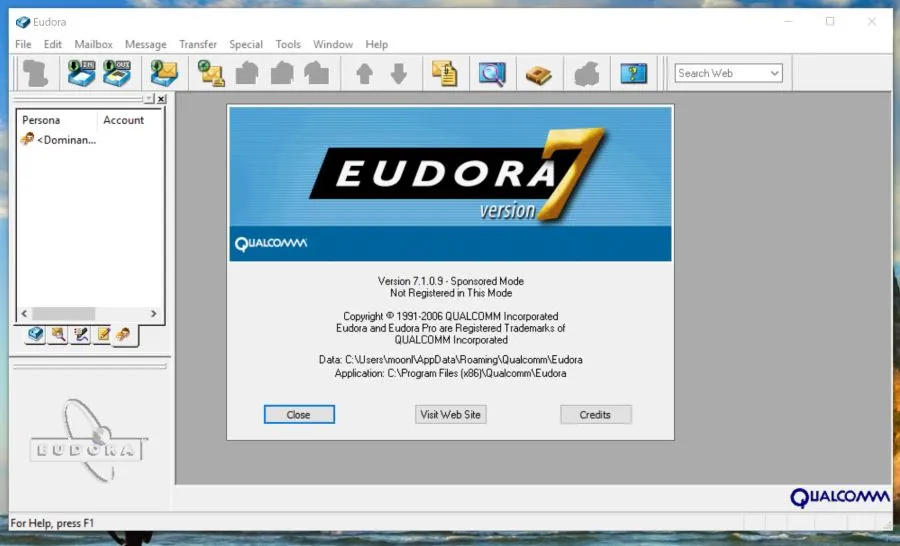
Eudora 7.1.0.9 — the last Windows release, running in the ad-funded Sponsored Mode — on a Windows 10 desktop, years after the program was discontinued. Screenshot from Wikimedia Commons, credited there to Qualcomm / Computer History Museum and published under the GPL.

2018: the source code goes public
In 2018, after five years of discussions with Qualcomm, the Computer History Museum published the Eudora source code under a BSD licence — permissive enough for personal and commercial use, with the usual requirement to keep the copyright notices, and one specific exclusion: the licence does not grant the Eudora™ trademark or the eudora.com and eudora.org domains.
What was released is the real thing, not a demo: 8,651 files in 565 folders (458 MB) for the Windows version, and 1,433 files in 47 folders (69.9 MB) for the Macintosh one. The museum added its own copyright notice and the licence, removed third-party components it had no right to distribute, and — at Qualcomm’s request — sanitised the profanity in the comments, which tells you something honest about how commercial software actually gets written.
The museum’s account of the release is worth reading in full, including a detail that matters here: in the first two weeks, around a thousand people answered their survey, roughly 40% of them still using Eudora, some with archives of 300,000 messages and more. Twelve years after the last release.
Those people had a very practical reason to stay. They had decades of mail in it, and moving decades of mail is exactly the thing that goes wrong.
The part that saves your archive: .mbx is mbox
Eudora stored each mailbox as a plain text file with an .mbx extension, alongside a .toc table-of-contents file that served as its index. The .toc is Eudora’s own; you can ignore it. The .mbx is mbox in all but name: messages one after another, each beginning with a From envelope line, headers, blank line, body.
Eudora’s envelope lines usually read From ???@??? rather than a real address — it filled in a placeholder — which looks alarming and changes nothing. The real sender is in the From: header where it belongs, and any parser that reads the headers instead of guessing from the envelope handles it. We checked ours against a mailbox written that way: dates, senders and subjects all come out correctly.
One thing genuinely is missing from the file, and it is worth knowing before you go looking: Eudora detached attachments. Rather than keeping them encoded inside the message, it wrote them to a separate attachments folder and left a line in the body reading Attachment Converted: "C:\Eudora\Attach\report.pdf". So a Eudora mailbox will show attachments as references, not as files — unless you also kept that folder. If you are recovering an old Eudora archive, copy the whole Eudora directory, not just the .mbx files.
Reading it today
Nothing needs converting, and nothing needs Eudora.
Mbox Viewer opens .mbx files directly on Mac and Windows — the extension is registered along with .mbox and .mbs, so a double-click is enough, with no renaming. mboxShell, the open-source terminal tool behind it, opens the same files from a shell on Linux, macOS, FreeBSD and Windows, and does not care about extensions at all.
Either way the file is read, never written: whatever survived on that drive stays exactly as it was. If your archive is broader than Eudora — Entourage, Netscape, PowerMail, Mulberry — our guide to reading old email archives on a modern Mac covers the rest of the family, and the history and anatomy of email formats explains why some of them survived and others took their mail with them.
What Eudora actually left behind
Ask what a dead program leaves and the answer is usually “nothing, and a folder you cannot open”. Eudora left something better: source code that anyone can read, and mail files that outlived the company, the operating system and the modem.
That is not luck. It is the consequence of one decision made in 1988 — store the messages as text, one after another, in a file the user owns. Every format that chose a proprietary database instead has spent the years since generating a small industry of recovery tools. Eudora’s archives just open.
Thirty-eight years is a long time for a file format to keep working. It is worth thinking about the next time you choose where your mail lives.
Eudora is a trademark of its respective owner. This article is not affiliated with or endorsed by Qualcomm or the Computer History Museum.
Open your archive with Mbox Viewer
Native Mac and Windows app. Streams MBOX and EML files of any size, fully offline.